Friday, March 27, 2020

Minimum Maintenance Response

It feels necessary to have a perfect entry to this post, but I don't know if that is even possible. One word, or sentence, can't describe the emotions and thoughts that have passed through our minds the past two weeks.  But, I do know this, our team has been awesome, working together through these strange times.  My first concern is their safety and well being.  

Tuesday March 17, 2020

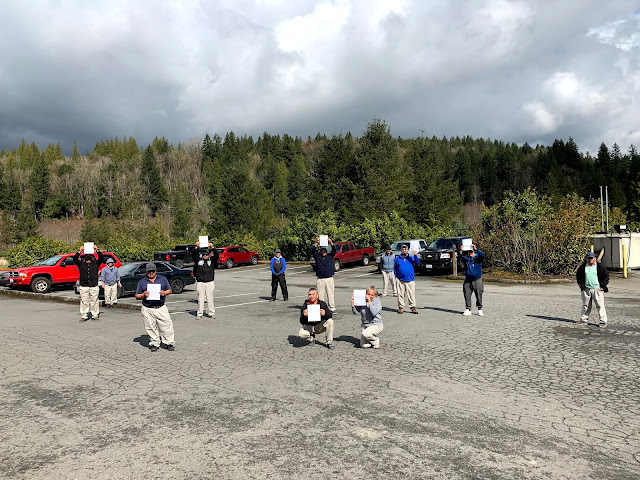
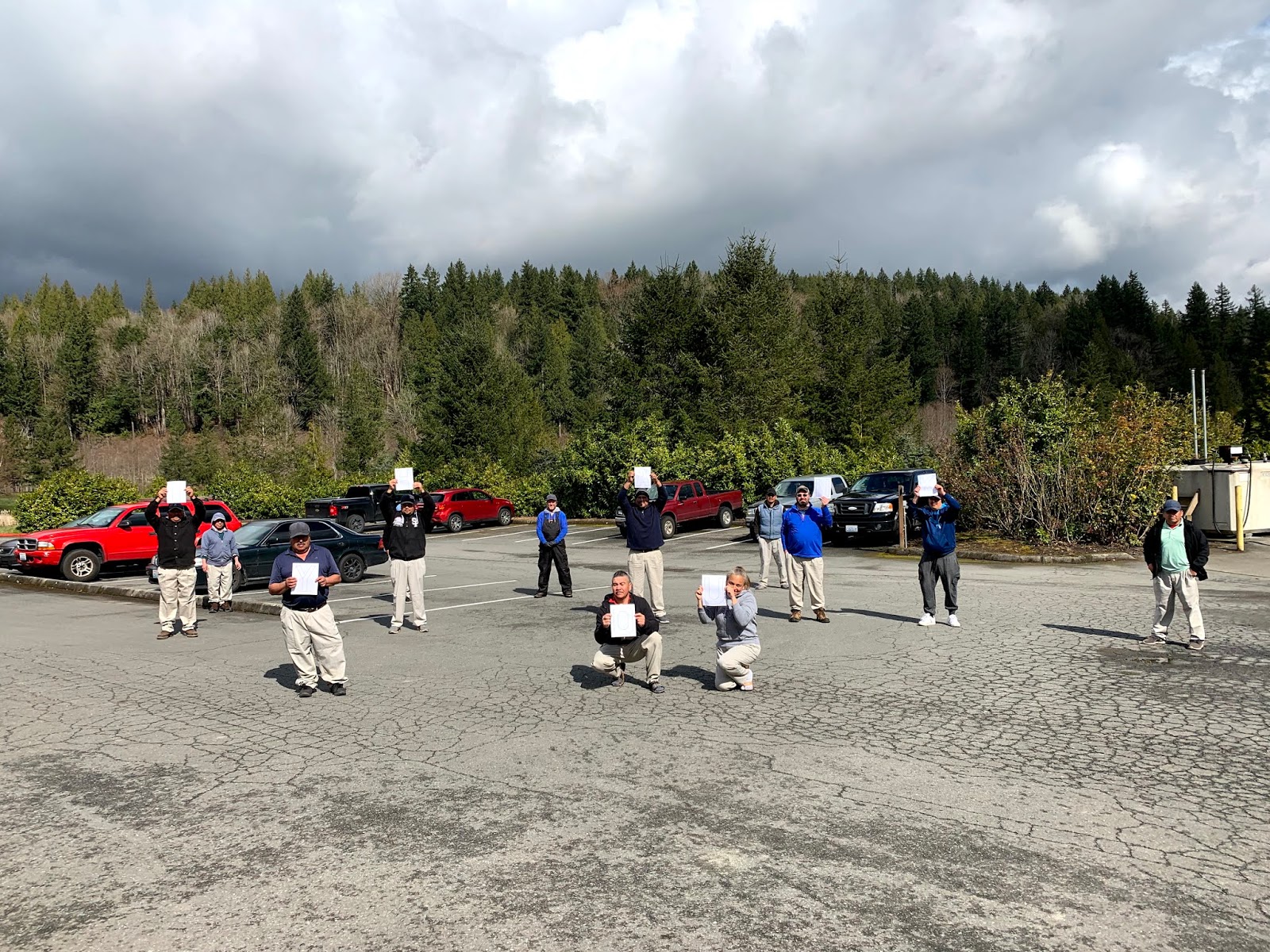
We made an immediate shift to conducting all staff meetings in the parking lot, practicing social distancing.   


 Trying to eliminate as many touch points as possible became our focus:
                        - No use of the break room
                        - One employee per cart
                        - Remove bunker rakes
                        - Extra disinfecting & cleaning of equipment
                        - Split lunch
                        - Remove timecards

The staff communicated to clear any hurdle and limit as many touch points as possible. I am very involved with the day to day operations and I quickly learned, I could be involved and empower the individuals on our team to solve this rubik's cube of challenges.  If I asked employees to be 'better', I needed to lead by example and use these circumstances as an opportunity to improve myself, for the safety and betterment of myself and the operation. 


Social Distance Golf

Version 2.0 of social distancing golf, results in the setup you see in the image.  The above ground cup was an issue for regular maintenance.  If we wanted to mow or roll greens, the cup, had to be removed (touch point) creating additional issues.  Colleagues posting on twitter helped come up with a solution that removed touchpoints, and streamline our maintenance.  Thank you to Richard Jones, our Equipment Technician for making this happen.


Golf course maintenance is naturally a form of social distancing and we see this as an opportunity to work within the new socially acceptable guidelines.   Last weeks sunshine helped productivity and ease our shift into these new procedures.  It also helped us breathe a little easier in a time of so much unknown.


March 23rd, 2020

Governor Inslee issues a 'Stay at Home' order

A few questions immediately came to mind: 
          What exactly does that mean for us?  
          Who or what is essential?  

California had determined golf would be closed, while New York was allowing golf to be open.  The Golf Alliance of Washington sent an official inquiry to the Governor's office for clarity on the order.  Within 24 hours the Governor Office received more than 3,000 inquires for clarification.  Our national association, GCSAA, has combined each states mandate into one document, for reference.

Here is the official order for Golf courses in Washington:


March 25th, 2020

Under the order to limit operations to minimum maintenance we put a plan in place, that myself and assistant managers had already discussed and planned for the possibility that it would need to be implemented.   Our priority was to get everything mown and our list of weekly tasks completed.  
Tee markers, garbage cans, flags, and all other accessories were removed from the course and locked away until further notice. 


March 27th, 2020

I've received numerous texts and emails about what our plans are during the mandated closure.  Here are a few of the most common ones:

What are your plans for aerification?

Lets focus this answer to greens aerification.  There is no plan to move up aerification during this mandate.  The bentgrass is not growing enough right now for aerification.   Aerifying now would create an opportunity for Poa to invade any open void, and contaminate our greens.  Aerification is an important tool each year for maintaining turf quality, but this year has resulted in our need to make adjustments.  However, the adjustment to increased topdressing and no aerification is not sustainable over the long term and would be detrimental if done every year.

One scenario our staff has discussed is only deep-tining greens.   We are considering this as an alternative, as it requires less contact, and heals more rapidly compared to our normal aerification process.


When we do open how long will you  keep the modified cups in place and other non-touch practices?

Great question, and hard to know exactly.  We will continue to follow CDC and Washington State guidelines.  Modified cups and no bunker rakes could be part of golf through Summer.

How often will you mow?

Mother nature will dictate most of that.  Simply put, we won't mow more often than we have to, but enough so that there isn't a decline in quality of turf.  

What does minimum maintenance look like?

That is a moving target right now.  We split the staff into different teams, working different shifts, which helps cover our ability to continue operations if one team were to become sick and needs to be quarantined. 
Many of the items we have prioritized during this mandate, won't be directly noticed when we return to golf.  Some examples of needs that we are tending to include;  raising sprinkler heads, walking path improvements, seeding rough and native areas are on the list. Continual evaluation of priorities will take place daily and allow us to adjust our operation for the safety of the staff and improvement of the golf course.  


If you zoom in far enough into the picture you can read the letters (words) the staff is holding up.  
It says "THANK YOU!"
Thank you to everyone who is doing their part to help others during this pandemic, and thank you to our membership and Board of Directors making it a priority to ensure the staff feels supported and safe.  I know I feel supported and safe, and thank you.  Please reach out to me if you have any questions.

My best to you and your family.  Be safe.


Friday, January 10, 2020

When does it rain?

"It rains a lot in Washington"  Growing up in the Pacific Northwest this is something you hear often from people who do not live here or did not grow up here.  My first maintenance job on a golf course was at the age of 15.  I worked full time in the Summer at Avalon Golf Links and weekends (when possible) throughout the school year to make extra cash, I continued that job through high school each and every summer since on different golf courses, in different states and different roles.  
My brother, Jon and I drove together many of those days with the windshield wipers clearing the way, dreading the day of rain ahead, 'what are we going to do today?' in the back of my mind, always worried that the rain gear wouldn't keep me dry through the day.  More days than not the skies seemed to clear and much of the work day would be absent of precipitation.
High school golf practice started in late February.  I can only recall a hand-full of days that we got rained out and couldn't practice.  I remember a particular day that got cancelled due to lightning, but that's a different story for a different day.


In January of 2007, I returned to Washington by accepting the Assistant Superintendent job, here at Aldarra Golf Club.  That first month it rained 3.38" (I had to look it up.)  Even though I grew up in this climate it was difficult to adjustment.  Rain events (and winter) were so different in Michigan and New Jersey, high rain total days occured in a few hours of rain or complete wash outs followed by sun.  In 2019, we had 4 days that the rain total was greater than 1" (average is 5 for Seattle) compared to New York City which had 15.

Jon sent me a message one day "80% of rain in Washington occurs at night."  A player on the team, which Jon was coaching, told him that in passing, who heard it from the Professor in his meteorology class that day.

Instantly, I  thought of all those days driving to work in high school and many days since, could this possibly be true?  In 2018 we purchased a new weather station that makes collecting and reviewing this data possible.   So, finding out the answer to this question or theory has been a decade in the making.  Day is defined as the time from actual sunrise to sunset and night as the actual time from sunset to sunrise.  There is a small grey area in there as the weather station only records rainfall totals per hour.  I tried to be as accurate as possible in splitting that line.


Here is the rainfall graph for November 18th, which had the highest rain total for a single day in November of 0.41 inches.  Sunrise was at 7:18am and sunset at 4:29pm.   Through the 5pm hour, it rained 0.19" So the day total was .0.19'" (44%) and it rained 0.23" (56%) at night.

I broke down each day and compiled that data into totals for each month of 2019.  (When I find time I might do 2018.)  Below is the breakdown for the month of November.


And the totals for each month of the year

Its not quite 80% but the data does show more rain occuring at night than during the day, two to one.  One year of data doesn't prove anything or show a trend, but its definitely interesting to note the difference.  So yes, it rains a lot in Washington, 185 days of measureable rain days this, but most of it occurred when its not possible to play golf.  


Wednesday, December 4, 2019

Intended Destruction

Maintaining a pure rough stand of Perennial ryegrass has been a goal (or dream) since Aldarra was built.  Numerous strategies have been implemented over the years.  The entire rough on #10 was treated with Round-up to eliminate all species of turf and re-seeded to ryegrass

That project was a success and has been copied in smaller areas through out the years.  We have sod cut out non-intended species (annual ryegrass, bentgrass, etc.) and replaced with ryegrass to improve the aesthetics and playability. 

The different stands of turf between the rough and fairway surfaces, presents the 'look' we want to achieve, highlighting the lines and contours of the golf course.

The backbone of this plan is the use of Prograss, a selective herbicide, that injures and eliminates Poa annua (annual bluegrass)  in a stand of ryegrass. A 'stand' of grass is defined as : a group of plants growing together in the same area.

Prograss application are made in the Fall, starting in late September with an additional application 24 - 30 days later.  A third application, if possible, is made in late February.  In a perfect world this application is made before the last hard frost of the Spring.  Over night lows below freezing following the last application has shown better results in annual bluegrass decline.  


This year has seen great results with the two Fall applications and i believe a lot of that is perfect timing and luck.  Three days after our first application (October 3rd) a heavy frost resulted in our first frost delay of the year.  I consider a heavy frost to be an overnight low below 30 degrees. The active ingredient of Prograss works by deteriorating the cell wall of Poa annua.  By breaking down the cell wall, the Poa annua plant is more susceptible to injury, due to frost.  


Due to the success of the two Fall applications, we will begin to renovate certain areas through winter as time and weather permits.  I'm often asked about 'when can you seed grass in the Pacific Northwest?'  While the ideal time would be Fall, first, if the opportunity presents itself to get this work done, we will take that it.  The important step in renovating these areas, is removing the dead or decaying organic matter and resulting in proper seed to soil contact needed for germination.    


Remaining areas will be renovated in the Spring, after the third application.   Immediately following the completion of renovation our Spring fertilizer application will go down to help grow/fill these areas in.  A lot of man hours goes into this process, but the end result is worth the effort.


Wednesday, November 13, 2019

A new edge


This picture from September of 2018 is of the first curbing replacement section upon completion.  I'm happy to write in November of 2019, after nearly two thousand five hundred linear feet later, we are finished.


The original curbing material used had been deteriorating for years.  The old stone was removed by hand and each new stone placed by hand.  The final product turned out better than I could have imagined.  A huge thank you to the crew and their attention to detail throughout this process.  They bought in to the idea and took pride (as they always do) in the finished product.  

The before and after of the curbing on 12 green, sums up the project better than any words and shows the improvement in detail throughout the property.  

This project was finished a year ahead our original schedule and within the budget planned.   Again, a huge thank you to our staff for taking pride in the final product.  You might see us adding curbs in the coming months to areas we feel need them that did not have them before.  


Thursday, April 18, 2019

Timeless

Time.  A part of golf we don't often recognize but are always facing. You have three minutes to find a lost ball(new rule), you have a tee time, you are encouraged to play in under 4 hours.  But at the end of the day the time you spend on a golf course should be something to connect you with nature and friends.  

When you finish putting out on the 18th green at St. Andrews, you might look up, note the time and determine if there is time for more golf.  

Image result for Royal and Ancient Clubhouse


Most golf courses have gone forward adding Rolex clock, Pebble Beach, Pinehurst, and Chambers Bay to name a few.  Usually near the clubhouse where the flow of the first tee and putting green can be seen from a common spot.

Image result for golf course clocks


Famous clocks are everywhere, discussed and used around the world, sometimes it is the most famous piece of architecture in the city.  There was an idea to create a classic look that would better suite the west elevation of the clubhouse.


Many of the clocks you see today are made by Electric Time located in Massachusetts just outside of Boston.  There design team helped create the design with my input.  It was always known that the A would represent the top of the hour.  The black colored markers on the clock and the 'brain' of the clock were made at there factory.  Now to have to it assembled. 


The clock measures nearly six feet tall.  Thank you to Kyle Montgomery, pictured above, and his team at TimberWorks Building for turning out a fabulous finished product.


In 2010, there was an idea to add a flag pole near the front of the clubhouse.  The idea was Bill Tindall's and what a fantastic idea it was.  When I see the flag flying in the wind I often think of Bill and smile.  A simple idea, executed well has left a mark, I hope the clock leaves a similar mark in time.


Friday, March 1, 2019

The Course is Closed, what has your crew been up to?


The deep freeze of 2019 continues, and the course remains closed.  Most of the snow has melted, but overnight lows in the 20s have resulted in frozen ground.  Its is quite difficult to predict a date for when the course will re-open.  On the positive side we have checked a lot of things off the TO DO list.  Here is a recap of a few of those projects.
We are adding a new hole location sign to the 5th tee, we got the work shop in order and turned out a great looking sign. 

These signs are made from cedar trees that have been removed from the property allowing us to re-purpose materials when possible.

Curbing replacement continues and we were able to get a project done that I have been eyeing since we started this project.  Cleaning up the appearance behind the 12th green is a great aesthetic improvement.  We have installed nearly 1,000 linear feet of curbing to date and have just less than 1,000 feet to go to finish the project.  Our plan is to be done by 2020 with all the work being done in house.  The staff has done a tremendous job with the details and the result is a great result.  Basalt was the stone chosen to replace the existing material and should have a much longer life than the original stone.


Before and After


Last winter we fabricated new garbage cans for the course and this winter we are taking it two steps further.  We are transitioning the bricks under these areas to match the bricks used at the driving range mat area to create continuity.  New water coolers are also being fabricated to better match the color and look of the garbage can.  Many thanks to a former Aldarra employee, Dean Owen, for taking on the fabrication of the water coolers.  It is going to take time to change over all of the bricks on the course. 


The stain used on all the course accesories is the same product that will be used on the soffit's around the clubhouse when they are refinished this season.  Below is a sneak peak of the new water coolers.  


 A huge thank you to Dean Owen for helping us with this project.  Dean was a long time employee of Aldarra and his stamp is all over many of the projects on the course, he created the brand you see on all the cedar benches and accessories.  Thank you Dean.

 Tree removal has also been taking place during the closure a continuation of previous years efforts to open site lines and improve turf conditions.  One of the biggest areas we were able to address was the view down the first fairway.  Alder growth on both side before the pond has reduced the sight lines through the years.  You can see from this picture taken before the course opened the original view of the fairway.  Compare that the view in the photo below from May of 2015.  This is the renewed view down the first fairway.


Compare that to the view in the phone from May 2015.  

This is the current view from the First tee


The prolonged closure has also allowed us to ‘clean-up’ a lot of areas that have become over grown in recent years.  Finding time to attend to these areas between daily maintenance is difficult.  Closures allow us to tend to these areas, improving details around the course.


The ground was not frozen before the snow fell and the micro-climate at the interface of snow and the turf is a perfect environment for Pink Snow Mold spores to reproduce and spread.  The timing of our fungicide applications didn’t line up with the environmental conditions due to the length of snow cover and many tees and fairways will have a higher rate of disease patches than we have seen in any other year.  This will have no negative effect on turf health but will take additional to time recover as temperatures warm-up going into Spring.  Additional applications (fungicide and fertilizer) will be made when mother nature cooperates to help recovery.
We are excited to get the golf course open and have people back enjoying the fruits of our labor.   Thank you for your patience and hope to see you out soon.


Sunday, January 20, 2019

Alder Removal


This is a photo of the 13th tee in 2001, a narrow tree lined corridor that has been thinned out in the past 18 years.  The plan to remove as many alders, has been in place for many years, due to their short life-span.  You may also remember the area between #11 & 12 littered with alders.


The view from 11 tee looks much different today than it did in 2001.  Improved play-ability and native grass quality is a long term benefit of removal. 


During a recent cold spell we were able to continue the strategy of removing alders to the left of the 13th tee.  Removal of these trees eliminates a lot of fall cleanup and will improve the quality of the native grass in this area.


The stumps need to be ground to finish the current phase, this is done in house with our own equipment.  The final phase of this project is planting Fir and Cedar trees later this year.  Don't forget to check out the improved view from the 11th tee.